SAFETY OFFICIALS URGE MOTORISTS TO AVOID DROWSY DRIVING
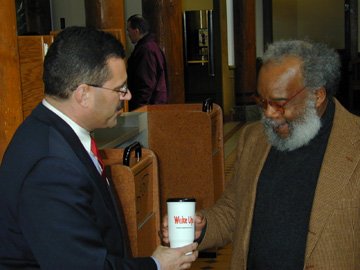
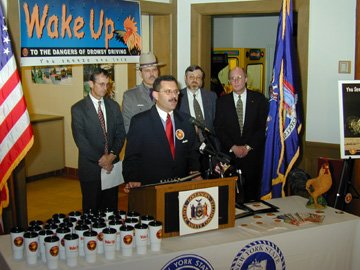
The informational campaign was launched in conjunction with National Sleep Awareness Week (March 26 - April 1) and serves as a timely reminder the week before Daylight Savings Time, April 1, when people could "lose" an hour of precious sleep. A ceremony was held at the Thruway Travel Plaza outside Albany (Guilderland) and ceremonies are planned for Wednesday at rest stops outside of Syracuse and Utica. Participants included representatives of the Governor’s Traffic Safety Committee (GTSC), National Sleep Foundation, Department of Motor Vehicles (DMV), State Police, Thruway Authority, AAA and the State Association of Traffic Safety Boards. The campaign materials feature stickers, posters, informational cards and travel mugs, that can be filled with free coffee from McDonald’s or HMS Services at the three event rest areas.
"NHTSA research shows that drowsy/fatigued driving is a factor in nearly 4 percent of all fatal crashes, claiming more than 1500 lives a year. They also account for at least 100,000 crashes in the United States," said Thomas M. Louizou, Region II Administrator for NHTSA. Commissioner Martinez added that "in New York State alone, police reports from 1996 through 1999 indicated driver fatigue as a contributing factor in at least 4,298 traffic crashes, and indications are that these incidents are grossly under-reported. People don’t always consider that lack of adequate rest may result in serious consequences, especially on the highway."
Driver fatigue affects all age groups, especially young adults aged 16 to 24, faced with the multiple demands of employment, education, and extra-curricular activity; long-distance truck drivers who often drive at night without stopping for breaks; and shift workers required to sleep in noisy daytime environments. "Drowsy driving can be deadly to you and your loved ones," said New York State Police Superintendent James W. McMahon. "I applaud the Governor’s Traffic Safety Committee, under the leadership of Commissioner and Chair, Raymond P. Martinez, for their public education campaign that has raised awareness of the dangers of driving drowsy and to help save lives." "The Thruway Authority is proud to participate in the Dangers of Drowsy Driving Campaign, a program aimed at raising the awareness of the dangers of driving while tired," said John Platt, Executive Director of the New York State Thruway. "Driving fatigue is a major cause of crashes on our highways each year. The Thruway has seen a 70 percent reduction in sleep-related accidents since the installation of rumble strips along our shoulders. However, we must do more to educate the driving public of the seriousness of this problem." Drowsy driving ranges from falling asleep at the wheel to simply not paying attention to driving because of fatigue or lack of sleep. Officials said warning signs include difficulty in keeping your eyes open, repeated yawning, having wandering or disconnected thoughts, drifting from your driving lane, or failure to remember the last few miles driven. Commissioner Martinez cautioned drivers to be well rested before travel and not to attempt staying awake by such remedies as opening a window, turning on air conditioning, or playing loud music. Studies show that another popular choice, consuming caffeine, provides only a short-term benefit in driver alertness. "The best approach is to get adequate rest beforehand, share the driving with a passenger or take a break every two hours or every 100 miles," Commissioner Martinez said. "It helps to take a nap, stretch, take a walk or get some exercise before resuming your trip." Additional information on highway safety is available from the GTSC web site at www.safeny.com |