 |
|
NYS
Department of Motor Vehicles
Governor's Traffic Safety Committee
|
|
 Child Safety Seats Index & Overview |
||
| Buckling up is
important to children's safety. But in many cases, the child is not secured in the
car seat correctly, the car seat is not installed in the vehicle properly, or the child
isn't buckled up at all. The safest place for all children under the age of 13 is in the back seat of a vehicle. For ALL child safety seats: Read the manufacturers directions for your child safety seat and the owner's manual for your vehicle to find out how to install your child safety seat. The child safety seat should be attached as tightly as possible with the vehicles' safety belt. The seat should not move more than 1 inch toward the front of the car or side to side. There should only be room for one finger under the harness straps at your childs' chest level. The harness clip should be positioned at the childs' armpit level. |
||
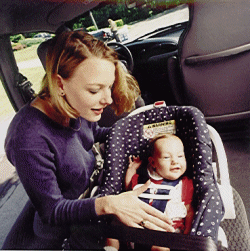 copyright 1999 Don Elliot Photography |
This is Kendall having her infant child
safety seat straps adjusted by her mom, Erin. Infants should be placed in rear-facing child safety seats until they are at least one year old and at least the minimum weight for a forward-facing child safety seat (generally 20 - 22 pounds). Children should remain in a rear-facing child safety seat as long as they do not exceed the height and weight limits of the child safety seat. The child safety seat should be semi-reclined at a 45 degree angle.
Never place a rear-facing child safety seat in the front seat of a vehicle equipped with a passenger-side air bag. |
|
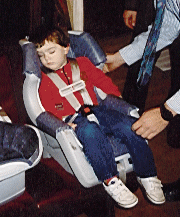 |
This picture of Corey was taken when he was
two-and-a-half years old. Children over age 1 and over the maximum weight and height limit for a rear-facing child safety seat are placed in a forward-facing child safety seat. Please follow the manufacturer's instructions for weight and height limits. In a convertible child safety seat placed in a forward-facing position, the harness straps should be through the top slot. Correct placement of the harness straps is important for securing the child in the seat. The harness straps come up over Coreys' shoulders and hold him snuggly in the seat. |
|
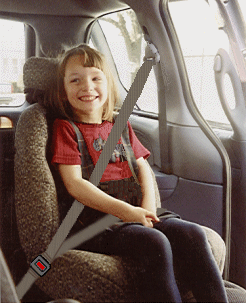 |
Meaghan is shown sitting in her belt
positioning booster seat. These seats are generally used for children whose
height or weight exceeds the limits of a convertible seat and who are not yet large enough
to comfortably or safely use a seat belt alone. The shoulder belt should go across the chest and shoulder and the lap belt should be over the upper thighs or hips. For more on proper seat belt fit, see below. |
|
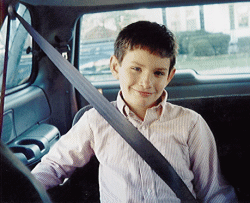 |
Willie, Meaghan's brother, is shown wearing a seat
belt. As you can see, the shoulder belt goes across his shoulder and collar
bone. It is not across his face or cutting into his neck. The lap belt should
be positioned across the upper thighs, not the abdomen. The child
must be tall enough to sit with their back against the seat back and their knees at the
edge of the seat without slouching. Until the child is large enough to properly fit in a seat belt, generally about 80 pounds, he or she should be in a booster seat. |
|
| http://www.nysgtsc.state.ny.us/seat-use.htm
-- Revised: January 14, 2003 Copyright © 2002 NYS Governor's Traffic Safety Committee |
 Find Answers |
Copyright 2003, NYS DMV, Office of
Internet Services
|



