 |
ITSMR
Research Notes |
NYS
Department of Motor Vehicles
Governor's Traffic Safety Committee
|
ITSMR
Research Notes |
IMPAIRED DRIVING ARRESTS
IN NEW YORK STATE
1996 - 1998
| INTRODUCTION Over the past several years, New York has continued to build its reputation as a leader in the field of traffic safety. Despite the fact that New York has over ten million licensed drivers serious and nine million registered vehicles, the number of fatal crashes and fatalities has continued to decline. To date, 1998 is New York's safest year on record. The fatality rate on the state's highways declined to an historical low of 1.22 deaths per 100 million vehicle miles traveled. New York's low fatality rate is the result of the combined efforts of a variety of factors, including legislative initiatives, traffic safety programs at the state and local levels, the activities of public interest groups, and programs sponsored by companies and organizations in the private sector. Among the most successful program areas is alcohol and highway safety. The cornerstone of New York's impaired driving program continues to be the Special Traffic Options Program for Driving While Intoxicated (STOP-DWI). Established in 1981, this highly acclaimed, self-sustaining program returns fines collected from impaired drivers to the counties where the violations occurred. These funds are used by the counties to support local initiatives to reduce impaired driving. In 1998, an estimated $23 million was returned to the counties through the STOP-DWI program. |
|
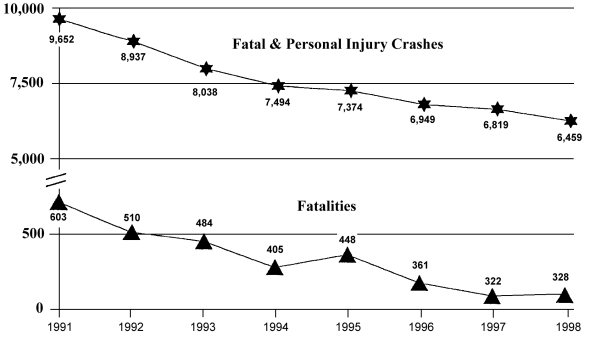
The success of the combined efforts of STOP-DWI and New York's other highway safety partners is evident in dramatic reductions in the numbers of crashes and fatalities involving impaired driving. As shown in Figure 1, the number of alcohol-related fatal and personal injury crashes dropped from 9,652 in 1991 to 6,459 in 1998, with the number of alcohol-related fatalities dropping from 603 to 328. These decreases represent declines of 33% and 46%, respectively.
To document the current status of New York's program in the area of alcohol and highway safety and to identify strategies that can be used to further reduce the incidence of impaired driving, a multi-faceted study is being conducted to examine what is known about alcohol-related arrests and convictions in New York State. Sponsored by the Governor's Traffic Safety Committee and conducted by the Institute for Traffic Safety Management and Research, this research bulletin presents the results from the initial phase of the study which focused on alcohol-related arrests. The study examined a number of variables, including the age, gender, and BAC level of the person arrested; the type of violation charged; and the arresting agency involved. Based on data obtained from the New York State Department of Motor Vehicles' Traffic Safety Law Enforcement and Disposition system (TSLE&D), the analyses focused on the three-year period, 1996-1998.1
FIGURE 1
ALCOHOL-RELATED FATAL AND PERSONAL
INJURY
CRASHES AND FATALITIES
NEW YORK STATE: 1991 - 1998
STATEWIDE ARREST DATA
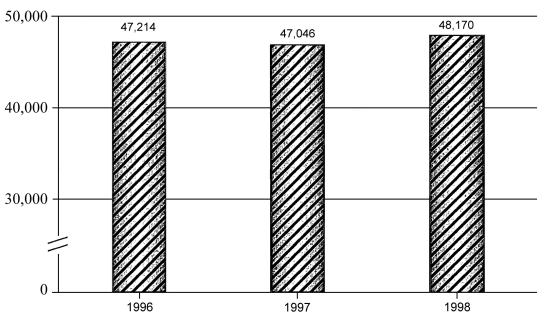
Enforcement of the impaired driving laws has been a high priority of most of the state's law enforcement agencies. As indicated in Figure 2, the number of persons arrested for impaired driving increased slightly from 47,214 in 1996 to 48,170 in 1998, an increase of 2%.
FIGURE 2
TOTAL PERSONS ARRESTED FOR IMPAIRED
DRIVING
TSLE&D AGENCIES: 1996 - 1998
AGE AND GENDER
Analyses by the gender of the drivers arrested indicated that approximately 84% of the drivers arrested in each of the three years were men and 16% were women. As shown in Table 1, while the proportion of drivers arrested who were in the age group 16-20 increased from below 8% in 1996 to 9% in 1998, the percentage of drivers arrested who were 25-34 years of age decreased from 35% in 1996 to 32% in 1998. The proportion of drivers arrested who were in the age group 21-24 remained constant at 14% over the three-year period.
TABLE 1
PERSONS ARRESTED FOR IMPAIRED
DRIVING BY AGE
TSLE&D AGENCIES: 1996 - 1998
| 1996 | 1997 | 1998 | ||||
| # | % | # | % | # | % | |
| Age Group | ||||||
| 16-20 | 3,638 | 7.7 | 4,039 | 8.6 | 4,274 | 8.9 |
| 21-24 | 6,801 | 14.4 | 6,651 | 14.1 | 6,895 | 14.3 |
| 25-34 | 16,453 | 34.8 | 16,039 | 34.1 | 15,342 | 31.8 |
| 35-44 | 12,554 | 26.6 | 12,594 | 26.8 | 13,411 | 27.8 |
| 45-64 | 7,028 | 14.9 | 7,027 | 14.9 | 7,512 | 15.6 |
| 65 + years | 714 | 1.5 | 664 | 1.4 | 699 | 1.5 |
| unknown | 26 | 0.1 | 32 | 0.1 | 37 | 0.1 |
Source: Compiled by the Institute for Traffic Safety Management and Research with data obtained from the NYS Department of Motor Vehicles' TSLE&D System, Winter 2000.
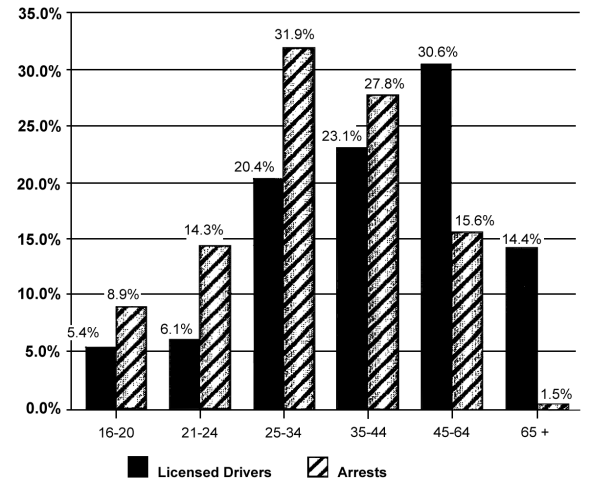
As indicated in Figure 3, young drivers continue to be over represented in impaired driving arrests. In 1998, while less than 12 % of the licensed drivers were under 25 years of age, 23 % of the drivers arrested for impaired driving were under 25. Similarly, while 20% of the licensed drivers were between 25 and 34 years of age, 32% of the drivers arrested for impaired driving were aged 25-34.
FIGURE 3
LICENSED DRIVERS AND PERSONS
ARRESTED
FOR IMPAIRED DRIVING BY AGE GROUP
TSLE&D AGENCIES - 1998
BLOOD ALCOHOL CONCENTRATION
Information on blood alcohol concentration (BAC) is available for drivers arrested by agencies covered by the TSLE&D system. The percentage of drivers for whom BAC information is available declined over the three-year period, dropping from 68% in 1996 to 65% in 1998. This decrease continues a previous downward trend, since BAC information was available for approximately 75% of the drivers arrested in 1992 and 1993. The decline in recent years may be indicative of a rise in the number of drivers who refuse to submit to a chemical test.
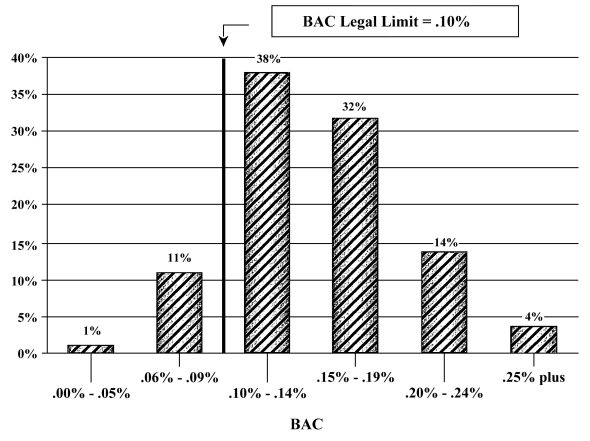
Analyses by BAC level indicates that very little change occurred over the three-year period, 1996-1998. The mean BAC remained constant at .1505% in 1996 and 1997, followed by a small decline to .1490% in 1998. Hence, the data for the three years were averaged and are depicted graphically in Figure 4. As shown in Figure 4, of the drivers arrested for impaired driving and tested, 38% had a BAC of .10% - .14% and 33% had a BAC of .15% - .19%. While 12% had a BAC below the per se level of .10%, 18% had a BAC over .20 %.
FIGURE 4
BLOOD ALCOHOL CONCENTRATION (BAC)
OF PERSONS ARRESTED FOR IMPAIRED DRIVING
TSLE&D AGENCIES
THREE-YEAR AVERAGE: 1996 - 1998
ARREST AGENCY
The percentage distribution of persons arrested for an impaired driving offense by type of police agency remained fairly constant between 1996 and 1998 (Table 2). Local enforcement agencies accounted for approximately 47% of the impaired driving arrests each year, with the remaining arrests being fairly evenly distributed between the State Police and the County Sheriffs.
TABLE 2
PERCENT DISTRIBUTION OF PERSONS
ARRESTED
FOR IMPAIRED DRIVING BY TYPE OF POLICE AGENCY
TSLE&D AGENCIES: 1996 - 1998
| 1996 | 1997 | 1998 | |
| State Police | 28 | 27 | 28 |
| County Sheriff | 26 | 26 | 25 |
| Local Police | 46 | 47 | 47 |
Source: Compiled by the Institute for Traffic Safety Management and Research with data obtained from the NYS Department of Motor Vehicles' TSLE&D System, Winter 2000.
TYPE OF VIOLATION
Arrests for impaired driving in New York State and related procedural matters are provided for under Article 31, Section 1192 of the V&T: Operating a Motor Vehicle While Under the Influence of Alcohol or Drugs. Section 1192 is subdivided into 12 parts. Sub-sections 1-6 pertain to arrest, while Sub-sections 7-12 pertain to procedural matters. The six sub-sections related to arrest for impaired driving are as follows:
| Sub-Section | Description |
| 1192.1 | Driving while ability impaired. |
| 1192.2 | Driving while intoxicated; per se. |
| 1192.3 | Driving while intoxicated. |
| 1192.4 | Driving while ability impaired by drugs. |
| 1192.5 | Commercial motor vehicles: per se - level I (.04-.07 BAC). |
| 1192.6 | Commercial motor vehicles: per se - level II (.08-.09 BAC). |
Analyses were conducted to identify the specific sub-section(s) of Section 1192 of the V&T for which each person was charged. As indicated in Table 3, approximately 68% of the persons arrested in each year were charged with a single violation of Section 1192 of the V&T and 32% were charged with two or more violations. In general, the largest proportion of drivers arrested each year were charged with the two offenses of 1192.2 and 1192.3, and the second largest proportion of drivers were charged with the single offense of 1192.23 (Table 3). While 1192.23 is not an official provision of the V&T, police agencies use this charge to represent a combination ticket of 1192.2 and 1192.3. The third largest percentage of drivers arrested for impaired driving were charged with the single offense of 1192.3.
In general, while little variation occurred from year to year in the distribution of charges by type of charge, the numbers of persons charged with the offense of 1192.4 (DWAI Drugs) experienced the greatest change over the three-year period. The number of persons charged with violating sub-section 1192.4 rose from 1,378 in 1996 to 1,825 in 1998, an increase of 31%.
TABLE 3
PERSONS ARRESTED FOR IMPAIRED
DRIVING
BY TYPE OF OFFENSE
TSLE&D AGENCIES: 1996 - 1998
| 1996 | 1997 | 1998 | |||||
| # | % | # | % | # | % | ||
| Total Number of Persons Arrested | 47,214 | 100.0 | 47,046 | 100.0 | 48,170 | 100.0 | |
| Charged with single offense | 32,790 | 69.4 | 31,963 | 67.9 | 32,733 | 68.0 | |
| Charged with two or more offenses | 14,424 | 30.6 | 15,083 | 32.1 | 15,437 | 32.0 | |
| Persons Charged with Single Offense | # | % | # | % | # | % | |
| 1192.1 | (DWAI) | 2,970 | 6.3 | 3,075 | 6.5 | 3,202 | 6.7 |
| 1192.2 | (DWI Per Se) | 4,006 | 8.5 | 4,182 | 8.9 | 3,752 | 7.8 |
| 1192.23 | (Comb 1192.2 &.3) | 13,457 | 28.5 | 12,527 | 26.6 | 13,007 | 27.0 |
| 1192.3 | (DWI) | 10,956 | 23.2 | 10,630 | 22.6 | 10,936 | 22.7 |
| 1192.4 | (DWAI Drugs) | 1,398 | 3.0 | 1,539 | 3.3 | 1,825 | 3.8 |
| 1192.5 or .6 | (Comm Vehicle) | 3 | *** | 10 | *** | 11 | *** |
| % | |||||||
| Persons Charged with Two or More Offenses | # | % | # | % | # | % | |
| 1192.1 & 1192.4 | 93 | 0.2 | 123 | 0.3 | 96 | 0.2 | |
| 1192.2 & 1192.3 | 13,427 | 28.4 | 14,100 | 30.0 | 14,420 | 29.9 | |
| Other Combinations | 904 | 1.9 | 860 | 1.8 | 921 | 1.9 | |
| *** Less than 0.1 percent | |||||||
Source: Compiled by the Institute for Traffic Safety Management and Research with data obtained from the NYS Department of Motor Vehicles' TSLE&D System, Winter 2000.
For further information regarding this Research Note, please contact:
Anne M. Dowling, Ph.D., Deputy Director
Institute for Traffic Safety Management and Research
80 Wolf Road, Suite 607, Albany NY 12205-2604
Phone: 518-453-0291; Fax: 518-453-0298;
E-mail: adowling@global2000.net
1 The TSLE&D system tracks tickets from the time they are printed to their final disposition. With regard to impaired driving arrests, all areas of New York State have been part of TSLE&D, with the exceptions of New York City and the five western towns of Suffolk County on Long Island, since July 1988.
http://www.nysgtsc.state.ny.us/rean112k.htm -- Revised: December 26, 2001
Copyright © 2002 NYS Governor's Traffic Safety Committee
 Find Answers |
Copyright 2003, NYS DMV, Office of
Internet Services
|


